
Baptism: I Commit Myself to Christ
-
By Fr. David Petras
 It was in speaking of baptism that St. John Chrysostom defined what a mystery of faith is, “We do not behold the things which we see, but some things we see and others we believe...I feel differently on these subjects than an unbeliever ... He, hearing of a washing, counts it merely as water; but I behold not simply the thing which is seen, but the purification of the soul which is by the Spirit.” (Homily 7, 2 on 1 Corinthians) We might go further and say that our baptism is our primary act of faith. The gift of faith is given by God, it is a divine virtue.
When we receive this gift, we must then take the next step, sealing the gift that has been accepted in our minds and hearts. We completely commit our whole being, body and soul, in the spiritual and physical rite of holy baptism, made up of a washing in water, an anointing with chrism as the seal of the gift of the Spirit, and our communion in the holy Body and Blood of our Lord Jesus Christ. This interior spiritual and physical commitment is also an outward expression of our faith, and a visible action of God, as he adopts us as his children, deifying us by the power of his Spirit, though, as Chrysostom noted, the spiritual reality cannot be grasped by our bodily eyes. Having been baptized, then, we live in an entirely new way and grow constantly in faith, until, as Nicholas Cabasilas wrote, “the life in Christ ... is perfected in the life to come, when we shall have reached that last day.” (The Life in Christ 1,1)We cannot understand faith without baptism. It is a real manifestation of a transformation of our lives. We are not the same person before and after baptism. This happens through a spirit of co-operation between ourselves and God (which we call synergy). We accept life in Christ by a formula of commitment called the syntaxis, “I commit myself to Christ.” We renounce Satan, in whom evil is personified, by a formula of rejection called the apotaxis, “I renounce Satan, and all his works, all his angels, all his service and all his pride.” We do this by our free will, though, since we cannot save ourselves, in the strength of God, who makes us his sons and daughters, feeding us with the bread of life and enabling us to keep his commandments. This was a very serious commitment, and the Epistle to the Hebrews says it cannot be abrogated, “it is impossible in the case of those who have once been enlightened (that is, received faith and been baptized) and tasted the heavenly gift and shared in the Holy Spirit and tasted the good word of God and the powers of the age to come, and then fallen away, to bring them to repentance again, since they are recrucifying the Son of God for themselves and holding him up to contempt. (Hebrews 6:4-6)” The Church, of course, has consistently taught that the God of mercy, who has commanded us to forgive seventy times seven times, is able to forgive us our sins and weaknesses and failures over and over gain, but this passage from Scripture shows how important our commitment to the good must be.
Baptism, then, as an act of faith is an acceptance of Christ and a rejection of Satan. Here in this sacramental mystery we see so very clearly that faith is not simply an “opinion” about what is true. It is a free decision enabled by the grace of God to live a new kind of life and to definitively turn from the paths of evil. This concrete decision is underlined in two ways: our decision for Christ is fortified by our recitation of the Creed, which is often simply called “the faith.” Faith is not a vague act of commitment, but an adherence to Jesus Christ, the Son and Word of God, born of the Virgin Mary as a human being for our sake. We live the life in Christ only when we, like him, are willing to lay down our lives for love of others. At the same time, our renunciation of evil is sealed by an exorcism of the power of the evil one in our lives. The priest breathes upon the person about to be baptized, saying, “Drive out from him (her), O Lord, every evil and unclean spirit hiding and lurking in his (her) heart: the spirit of deceit, the spirit of wickedness, the spirit of idolatry and all greed, the spirit of untruth and every impurity brought about by the prompting of the devil.”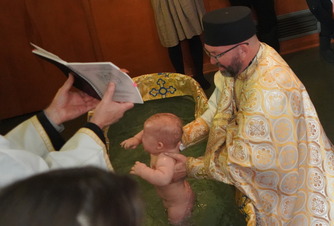 Because most of us are baptized as infants, some believe that this exorcism is unnecessary. Unfortunately, we are too influenced by popular cultural icons of demon possession. Evil wants us to think that it is not serious. The world, however, is under the power of evil, which prefers to take on a pleasant and appealing form in place of ugliness, though its true nature will be inevitably revealed. The exorcism in baptism is not, therefore, an ugly expulsion of an ugly but comical devil, but the recognition that we can escape the power of evil only by the power of the Spirit. Even babies need this protection from the beginning to escape the power of evil in the world. In the life of our Lord, we see that good is the courageous power to love God and our neighbor at any cost, while evil is a cowardly coddling of ourselves. Thus, when his disciple, Peter, tries to dissuade Jesus from giving up his life for others, Jesus labels this as evil and says to Peter, “Get behind me, Satan! (Matthew 16:23)”
 Baptism is the foundation of our faith. In its narrow meaning, we think of simply as a rite that is celebrated once, but the reality of baptism as the turning from evil and a total commitment to Christ lasts throughout life. Since we cannot live in Christ without his grace, baptism is God constantly acting in our lives. This synergy between God and us must be a living reality, so that every time we do God’s will the Spirit is moving us, and every time we receive Communion, God feeds our bodies and souls. What St. John Chrysostom said about the presence of mystery in baptism is then fulfilled, “[The unbeliever] considers only that my body has been washed; but I have believed that the soul also has become both pure and holy; and I count it the sepulcher, the resurrection, the sanctification, the righteousness, the redemption, the adoption, the inheritance, the kingdom of heaven, the full out-pouring of the Spirit. For not by the sight do I judge of the things that appear, but by the eyes of the mind." (Homily 7, 2 on 1 Corinthians)