The Byzantine Catholic Church
-
 Metropolitan WilliamThe Byzantine Catholic Church in America is a self-governing ("sui iuris") Church presided over in charity by His Holiness Pope Leo XIV and His Eminence, Metropolitan Archbishop William. Along with 23 other self-governing Catholic Churches (including the Latin, or Roman, Church), we profess the same faith and practice the same seven Holy Mysteries (Sacraments). The Eparchy of Phoenix oversees these Byzantine Catholics in the Western United States (learn about our eparchy).
While being united in full communion with the Pope of Rome within the universal Catholic Church, we have received our own particular liturgical and theological traditions from the apostolic age.
Those familiar with the Eastern Orthodox Churches will notice that their worship is nearly identical with ours. This is because we share in the use of the Byzantine Rite and have a common ancestor – namely the undivided Church of the first millennium, when all Western and Eastern Christians were united in one communion of faith.
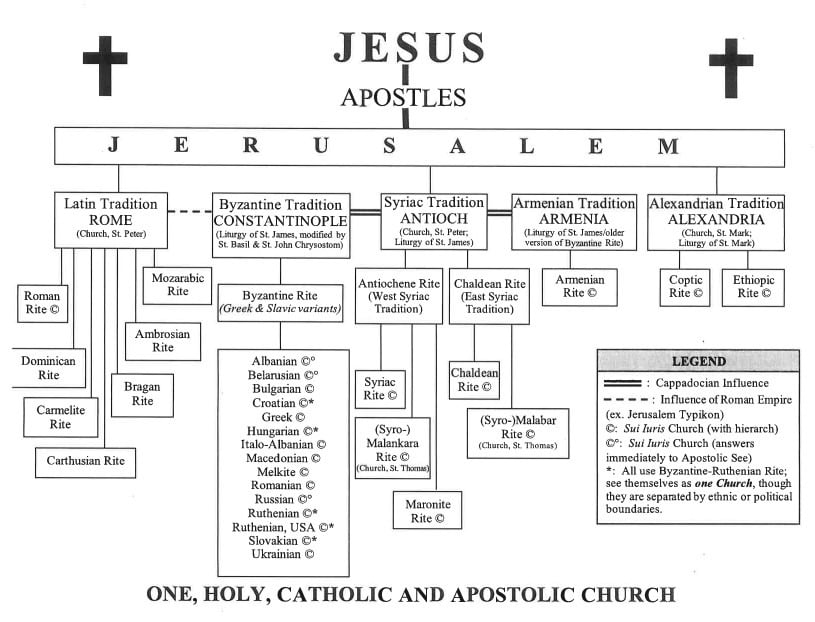
The preservation of unity among these 23 Eastern Catholic Churches (see graphic below) with the Roman Pontiff bears witness to the hope of fulfillment in Christ’s prayer “that they may be one” (John 17).

-
THE DIVINE LITURGY & HOLY COMMUNION
In the Byzantine Rite, the Mass or Eucharistic Service is called the Divine Liturgy. All Catholics who are properly disposed per USCCB guidelines may partake of Holy Communion in any Eastern Catholic Church. Attending an Eastern Catholic Church also fulfills any Catholic’s Sunday or Holy Day obligation.
 The Divine LiturgyThe Divine Liturgy is celebrated with great solemnity and is chanted or sung in its entirety, even on ordinary weekdays. Incense is always used. It is customary to stand throughout the Divine Liturgy, except during the Epistle and Homily. Those familiar with the Roman Mass will notice that we do not kneel on Sundays, as kneeling is considered penitential in our tradition, rather than reverential. We do, however, kneel and prostrate throughout the weekdays of the Great Lent.
To receive the Divine Eucharist, come forward with the congregation. When you approach the chalice, please cross your arms, tilt your head back, and open your mouth without extending your tongue. The priest will drop a particle of Our Lord’s most pure Body soaked in his precious Blood into your mouth. There is no need to say “Amen.” Please note: the priest may ask your name. We do not administer Holy Communion in the communicant’s hand. If you are not receiving the Eucharist you may put your finger over your mouth in a "shh" position to receive a blessing from the clergy.
Coming to a Byzantine Catholic Church for the first time may seem daunting and overwhelming. If you are having trouble following along, please ask for assistance or simply listen and let the beauty of our Liturgy wash over you.
Many of our parishes have a potluck or coffee hour after Liturgy. Please feel welcome to stay and have fellowship with us!
OUR CHURCH'S HISTORY
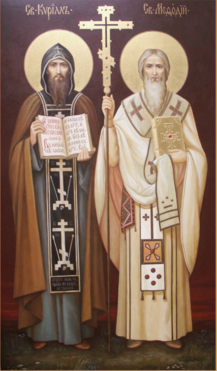 Saints Cyril & MethodiusThe Slavic peoples were evangelized by the holy Equals to the Apostles Cyril and Methodius, two brothers who began translating the Holy Gospel and liturgical books into the Old Slavonic language. A little over a century after St. Methodius’ death, the Grand Prince Vladimir converted to Christianity and adopted the Greek Rite of Constantinople (formerly known as Byzantium) as the official religion of Kievan Rus’. After the Great Schism between the Latin and Greek Churches in 1054, the Churches of the Rus’ gradually drifted out of communion with Rome.
Multiple attempts at reunion were made between the two communions. After the Union of Florence (1445) dissolved, the Holy See welcomed smaller groups of Orthodox Christians that sought reunification.
Thanks to the efforts of the holy Martyr Josaphat, bishop of Polotsk, most of the Orthodox bishops of Poland-Lithuania re-entered union with Rome at the Union of Brest, thus forming the Ukrainian and Belarusian Greek Catholic Churches in 1595. The Unions of Užhorod (1646, 1652) laid the foundation for the modern Ruthenian Greek Catholic Church of the Eparchy of Mukachevo (Ukraine), Slovakia, Hungary, Canada and the United States. In addition the Union of Marča (1611) in Croatia resulted in the formation of a multi-ethnic Church centered at Križevci which has strong ties to the eparchy of Mukachevo and the Church in Slovakia.
In the United States, the Ruthenian Greek-Catholic Church began calling itself the Byzantine Catholic Church in order to indicate that is it a Catholic Church for all peoples, not just those of Rusyn background. The modern Ruthenian Church includes the Byzantine Catholic Eparchies of Passaic, Parma, and Phoenix, the Metropolitan Archeparchy of Pittsburgh, the Greek-Catholic Eparchy of Mukachevo, the Metropolia of Hajdudorog (Hungary), the Exarchate of the Czech Republic, the Metropolia of Presov (Slovakia), and the Slovak Exarchate of Sts. Cyril & Methodius of Toronto.
WHAT WE BELIEVE
The Byzantine Catholic Church professes the same faith as the Roman Catholic Church and the other Catholic Eastern Churches. However, in accordance with Apostolic tradition, we express that faith in our own unique way. Some differences in theology and practice between us and the Latin Church include:
- we do not recite “and the Son” in the Nicene Creed.
- we use leavened bread in the Eucharist, and always received under both species, body and blood.
- we make the Sign of the Cross from right to left, with our first three fingers held together to symbolize the Holy Trinity and last two fingers together to symbolize the dual nature of Christ as God and man.
- infants are chrismated (confirmed) and communed when they are baptized, and continue receiving Holy Communion throughout their childhood (no First Communion).
- rather than the Dominican Rosary, many of us pray the “Prayer Rule of the Theotokos” as taught by St. Seraphim of Sarov, though primarily we pray the Jesus Prayer, “Lord Jesus Christ, Son of God, have mercy on me, a sinner” on our knotted prayer ropes.
- we have our own Code of Canon Law, promulgated by Pope St. John Paul II in 1990.
- married men may be ordained to the holy priesthood and diaconate, though they may not marry after ordination.
- the Holy Mystery of Anointing is administered at least once-a-year to all the Christian faithful (specifically on Holy Wednesday).
- our ecclesial structure is local and synodal, under the personal and ordinary authority of the Metropolitan Archbishop of Pittsburgh and subject to the authority of the Roman Pontiff.
- together with both the Latin and Greek fathers, we profess that Our most-holy Lady, the Theotokos and ever-Virgin Mary, experienced a painless falling asleep in the Lord before her Assumption, body and soul, into Heaven. We call this her “Dormition” and celebrate both her Dormition and Assumption on August 15th.
- the Great Fast, or Lent, begins on Pure Monday rather than Ash Wednesday, and traditional fasting and abstinence are kept more strictly than in the modern Latin Church.
The Church generally receives converts through the Catechumenate, culminating in the Mysteries of Initiation (Baptism, Chrismation, and Holy Communion) on the eve of Pascha (Easter).