
Introduction To The Divine Liturgy
-
The Divine Liturgy: The Sacrifice of Praise- by Fr. Anthony Hernandez
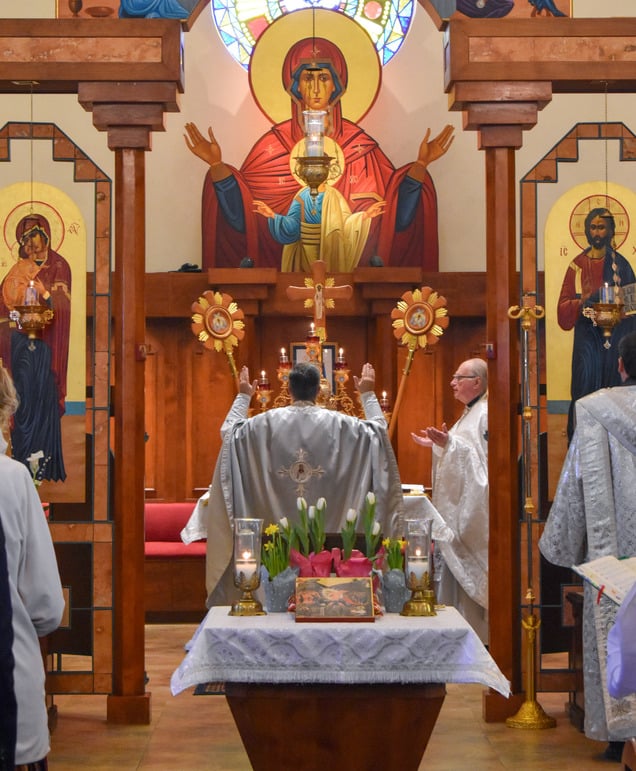 The Holy Eucharist, the Church's sacrifice of praise and thanksgiving, has been celebrated in a variety of ways at different times and places. The name for the Eucharistic celebration has also varied. Some Eastern Christians call it the Divine Liturgy, others Holy Qurbana (Offering). Western Catholics usually call it Holy Mass. Despite the many differences, there are still basic elements of the Eucharistic celebration that are common in all its forms.
Around 150 A.D., St Justin the Philosopher and Martyr wrote a description of an early Christian celebration of the Holy Eucharist. His description provides us with an outline of the basic parts of the Eucharistic celebration:On the day that is called Sunday we have a common assembly of all who live in the cities or in the outlying districts. The memoirs of the Apostles or the writings of the Prophets are read, as long as there is time. Then, when the reader has finished, he who presides over the assembly speaks to all present, challenging them and inviting them to follow the good things presented in the holy writings.
Then we all stand up together and offer up our prayers; and, after we finish our prayers, bread and wine and water are presented. He who presides then offers up prayers and thanksgivings, to the best of his ability, and the people express their approval by saying Amen.
The Eucharistic elements [the sanctified Gifts] are distributed and consumed by those present. The deacons are sent out to bring the Eucharist to those who are unable to be part of the assembly. The wealthy, if they wish, contribute whatever they desire, and the collection is placed in the custody of him who presides. With it he helps the orphans and widows, those who are needy...
All Christian Liturgies are composed of various parts, each having its particular purpose. In the Byzantine Christian tradition, before the public beginning of the Liturgy, there are three sequences of rituals:- Prayers Before the Iconostasis: Prayers are recited by the priest(s) and deacon(s) in. front of the iconostasis as a spiritual preparation for ministering at the holy altar.
- Vesting of the Clergy: The priest and deacon put on their sacred vestments while saying prayers that indicate the symbolic meaning of each vestment.
- The Proskomedia {Offering) also called the Prothesis (setting forth): The gifts (bread, and wine mixed with water) are prepared at a table on the northern side of the altar area.
The Liturgy of the Word / Liturgy of the Catechumens:
The Enarxis (Greek for the Beginning):- Blessing: Blessed is the Kingdom of the Father...
- Litany of Peace (Ektenije of Peace): In peace, let us pray to the Lord...
- Antiphons- 1st and 2nd Antiphons are composed of Psalm verses and a refrain.
- Hymn of the Incarnation: Only Begotten Son (Monogenes)
- Third Antiphon - Also composed of Psalm verses or the Beatitudes
- The Little Entrance: Procession with the Book of the Gospels
- Troparion & Kontakion: One or more troparia and kontakia are sung according to the tone of the week or feast day.
- Another chant, the Theotokion (honoring the Theotokos), may also be sung.
- The Trisagion: The thrice holy hymn: Holy God, Holy (and) Mighty, ...
 The main part of the Liturgy of the Word is composed of Scripture readings and chants. We listen to the readings and open our minds and hearts to what God offers us, especially through the Divine Eucharist. The Word of God in Scripture is God's message to us today.
In earlier times the catechumens were only allowed to attend this part of the Divine Liturgy. That is why it is often called the Liturgy of the Catechumens.
Chants Before the Readings- The Prokeimenon (pro-kee-men-on) - Usually composed of verses from the Psalms. It has a response and a verse.
- The Alleluarion (alle-lu-ah'rion) - This chant is composed of a triple Alleluia (Hebrew, meaning "praise to the Lord"), together with verses usually taken from the Psalms.
The Readings from Holy Scripture
At the Divine Liturgy the readings are from the New Testament only. (Old Testament lessons, also known as Paremia or Prophecies, are read on various occasions at Vespers).- The Apostolic Reading/Epistle - This reading is usually from one of the New Testament Epistles or Letters. During the season of Pascha this reading is from the Acts of the Holy Apostles. The book that contains these readings is called the Apostol.
- The Holy Gospel - This reading is taken from one of the Gospels: Matthew, Mark, Luke or John. On a few occasions, the Gospel reading is composed of various verses from several Gospels. The Gospel readings are proclaimed from the Book of the Gospels or Evangelion.
A homily is a talk given in which a priest or deacon explains the Scripture readings and shows how they apply to our lives today. At the Divine Liturgy, the homily is delivered after the Gospel Reading. As a norm, a homily is preached on Sunday and greater holy days.
Litany of Fervent Supplication
This litany is marked by several petitions responded to with a three-fold "Lord, have mercy".
Litany for the Departed
In this litany we pray for the souls of those who have fallen asleep (died) in Christ. This is basically the same litany used in the Panachida service for the departed.
Litany for the Catechumens
This litany, offered for the catechumens, is usually used only if there are catechumens in the community.
Dismissal of the Catechumens
Traditionally the catechumens were dismissed from the church at this point.
The Liturgy of the Holy Eucharist: The Liturgy of the Eucharist is also known as the Liturgy of the Faithful. The faithful are those who have been fully initiated into the life of the Church by the holy Mysteries of Baptism, Chrismation, and the Divine Eucharist. The faithful, as a priestly people (see 1 Peter 2:9), participate in the holy and life-giving sacrifice, the Holy Eucharist.
During His last Supper, our Lord Jesus Christ took the bread and the chalice (cup), blessed them, broke (the bread) and then gave the sanctified Bread and Chalice to His disciples. These four actions provide an outline of the Liturgy of the Eucharist.
He took...
Before the public celebration of the Divine Liturgy, there is a rite of preparation called the Proskomedia or the Prothesis. The gifts of bread and wine are prepared and covered with veils. At the Great Entrance, the bread and wine are taken from the Proskomedia table and brought to the Holy Table in a solemn procession. These ceremonies, the Proskomedia, and the Great Entrance, and all the actions and prayers that accompany them, correspond to the action of Christ "He took bread ...He took the chalice. "
He blessed...
The Anaphora is the great Prayer of Offering. We hear of the wonderful things that God has done in creation and in bringing about our salvation. The priest recalls what Christ said and did at the Mystical Supper. "This is My Body ...broken for you" - "This is My Blood ...shed for you" - "Do this in remembrance of Me. " The priest says the Epiclesis (invocation of the Holy Spirit) over the holy Gifts and the bread and wine are changed into the living and life-giving Body and Blood of Christ. The Anaphora, composed of words and gestures, corresponds to the action of Christ: "He blessed it. "
He broke...
After the sanctification of the Holy Gifts, and prior to Holy Communion, the Lamb (Slavonic: Agnetz), the sanctified Bread, is broken into particles for distribution in Communion. The actions and prayers associated with the Breaking of the Brad correspond to the action of Christ: "He broke the bread."
He gave...
Finally, the most holy Body and Blood of Christ are distributed to the people in Holy Communion. This distribution corresponds to the action of Christ: "He gave it to them. "
Proper Dispositions in Celebrating Liturgy
In order to offer more perfect worship to God and to better receive all the blessings He offers, we have to participate in the Liturgy with the right dispositions. We cannot be merely present in body, but also with our hearts and minds.
The Divine Liturgy is the Church's celebration of Christ's Passover from death to life. Our Lord said: "Do this in remembrance of Me.'' We remember all that Christ did for us. We recall His suffering and death, His resurrection and sitting at the right hand of the Father. At the same time, the Divine Liturgy is the work of God. God is the one who gathers us as a people and gives us the ability to offer fitting worship. The Liturgy is a unique and privileged time in which the Lord Himself acts today for our salvation. When the Church assembles to remember the saving works of Christ, God also "remembers", and He makes present and real to us today all that Christ has done for us. The Holy Spirit then bestows upon us the spiritual gifts gained for us by Christ's saving works.